
1924 to 1941
Herman H. Wedgworth’s research
Before he founded the company, Herman was a plant pathologist in Mississippi, Michigan and Florida.
This page lists everything we found in print by him or crediting his work, 1924 to 1941. Free copies of his main works are hosted here so they don’t depend on outside sites.
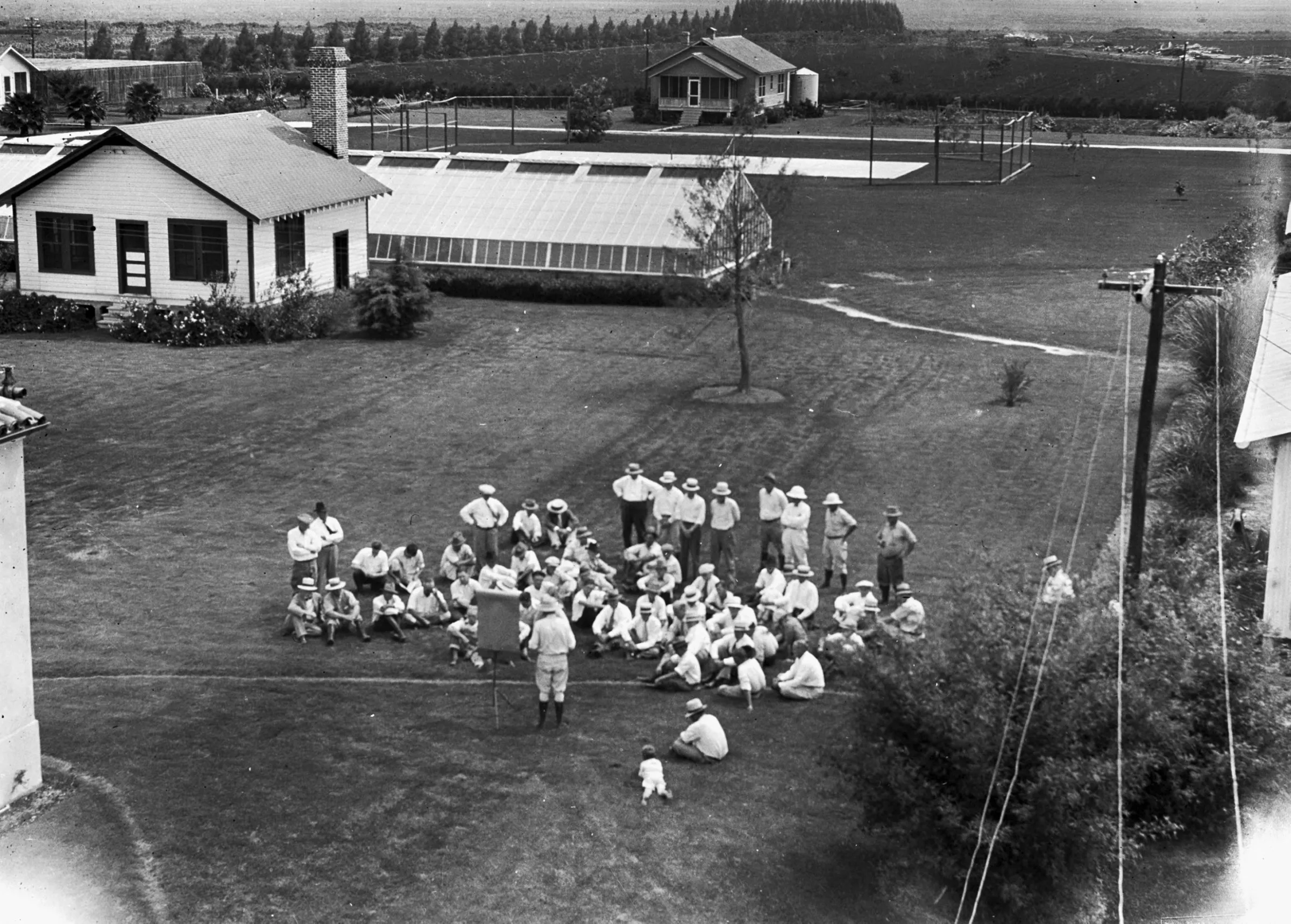
Photo: bean growers with Herman at the Everglades Experiment Station, 1931. University of Florida Archives (opens in a new tab)
134
Items in print 33 free copies hosted here
- 1901 Born September 3 in Lauderdale, Mississippi
- 1922 B.S., Mississippi A. & M. College (now Mississippi State)
- 1922–1924 National Research Council sulphur fellow at Michigan Agricultural College (now Michigan State). M.S. 1924.
- 1924–1925 Inspector, State Plant Board of Mississippi, at the Raymond Branch Experiment Station
- 1925–1926 Graduate student and instructor in plant pathology, Cornell University
- 1926–1928 Assistant, then Associate, Plant Pathologist, State Plant Board of Mississippi and the Mississippi Agricultural Experiment Station
- 1928–1930 Fruit disease research, Michigan State College
- 1930–1932 Associate Plant Pathologist, University of Florida Everglades Experiment Station, Belle Glade
- 1932–1938 Farmed at Belle Glade and founded Wedgworth Farms and the fertilizer business
The catalog
134 items in print
His thesis, bulletins, circulars, articles and reports first, then the shorter field notes and records, oldest first.
Main works
34 items
-
1924 · Thesis · Michigan
Investigations on the relation of sulphur to the actinomyces scab of potato
Herman H. Wedgworth
M.S. thesis, Michigan Agricultural College, Dept. of Botany · 3 unnumbered pp., 69 leaves, ill., 29 cm
Thesis on treating soil with sulphur against potato scab. The field work was done during his National Research Council fellowship, funded by Texas Gulf Sulphur Co.
No online copy. Held on paper and microfilm at the Michigan State University Libraries.
-
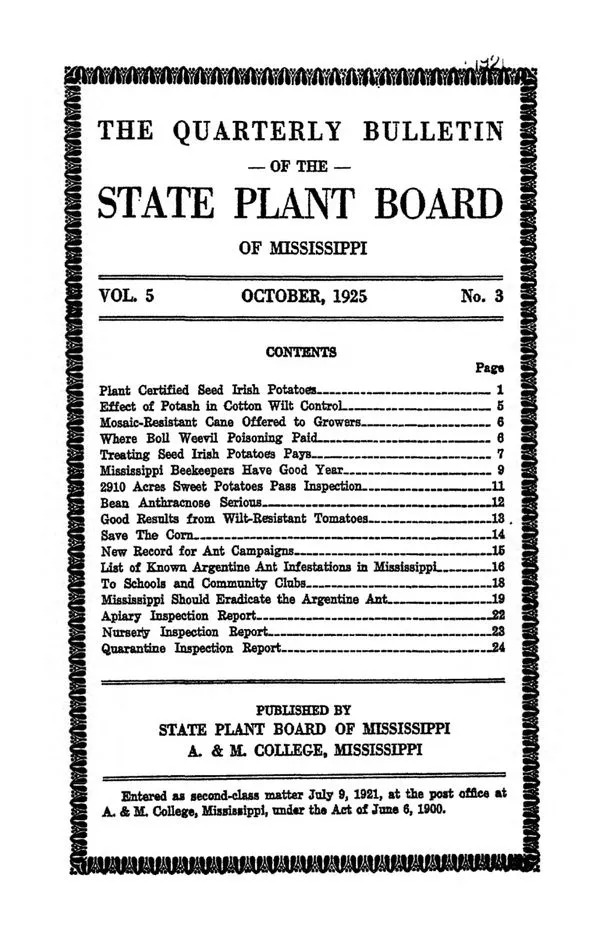
October 1925 · unsigned report of his work · Mississippi
Plant certified seed Irish potatoes this time
Unsigned (State Plant Board staff); reprints Wedgworth & Anders
Quarterly Bulletin of the State Plant Board of Mississippi · Vol. 5, No. 3, pp. 1-4, figs. 1-4
Credits his workReprints the opening of Circular 60. Certified Nebraska seed yielded 204.62 bu/acre against 110.7 bu/acre for uncertified seed at Raymond in 1925.
Read PDF (opens in a new tab) Source (opens in a new tab) HHW-007
-
October 1925 · unsigned report of his work · Mississippi
Treating seed Irish potatoes pays
Unsigned (staff); reports a test by H. H. Wedgworth
Quarterly Bulletin of the State Plant Board of Mississippi · Vol. 5, No. 3, pp. 7-9, figs. 5-6
Credits his workA 30-minute dip in corrosive sublimate gave 93-96% clean tubers, against 12-23% from untreated seed. Refers readers to Circular 61.
Read PDF (opens in a new tab) Source (opens in a new tab) HHW-008
-
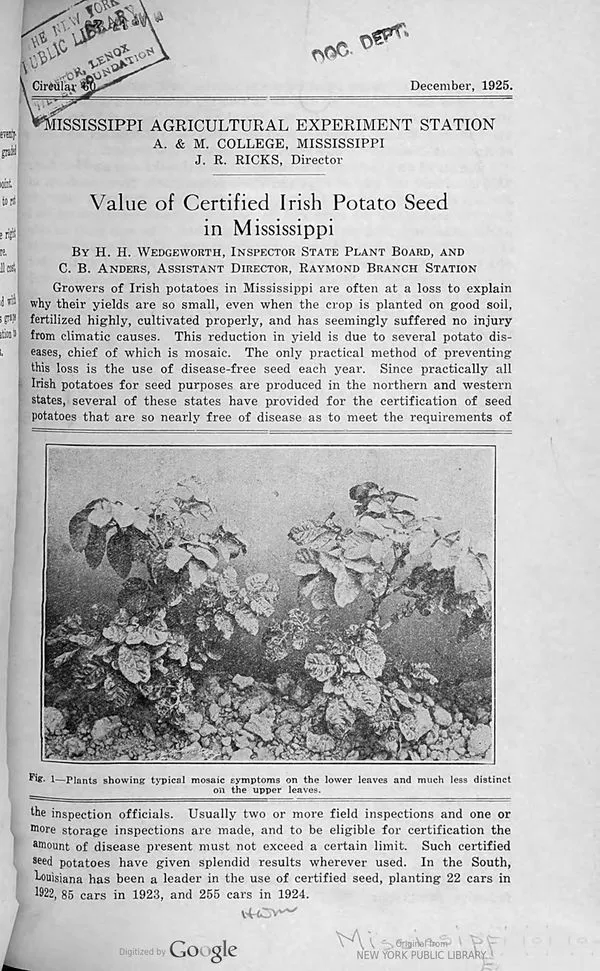
December 1925 · Bulletins & circulars · Mississippi
Value of certified Irish potato seed in Mississippi
H. H. Wedgworth and C. B. Anders
Mississippi Agricultural Experiment Station Circular · Circular 60, [4] pp.
Read PDF (opens in a new tab) Source (opens in a new tab) HHW-009
-
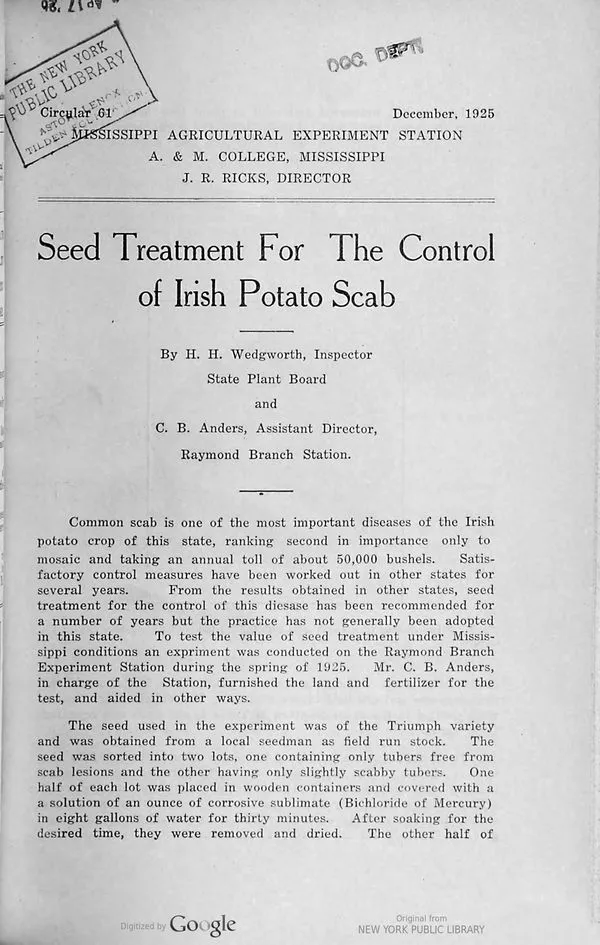
December 1925 · Bulletins & circulars · Mississippi
Seed treatment for the control of Irish potato scab
H. H. Wedgworth and C. B. Anders
Mississippi Agricultural Experiment Station Circular · Circular 61, 4 pp.
Read PDF (opens in a new tab) Source (opens in a new tab) HHW-010
-
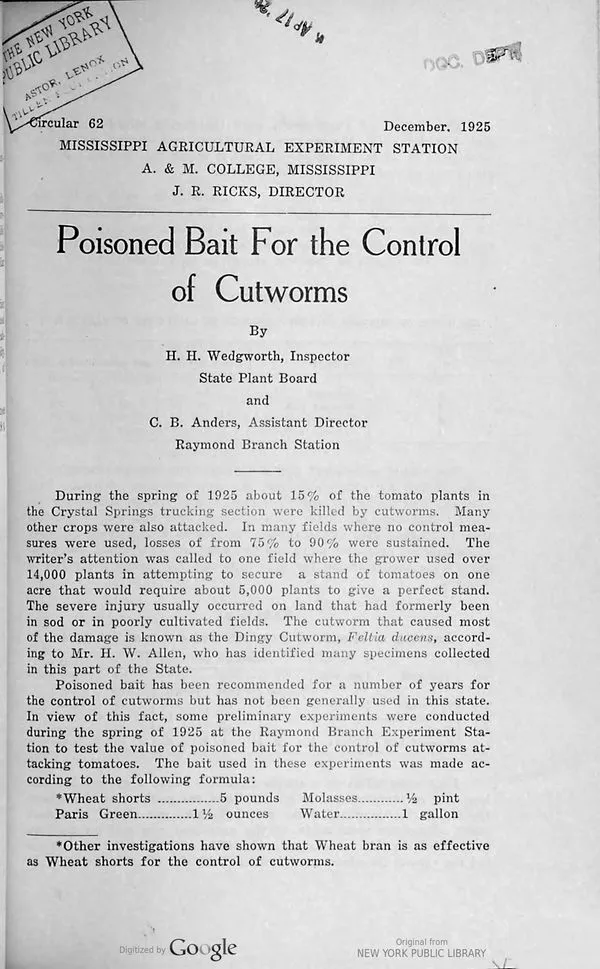
December 1925 · Bulletins & circulars · Mississippi
Poisoned bait for the control of cutworms
H. H. Wedgworth and C. B. Anders
Mississippi Agricultural Experiment Station Circular · Circular 62, 3 pp.
Read PDF (opens in a new tab) Source (opens in a new tab) HHW-011
-
January 1926 · unsigned report of his work · Mississippi
Controlling cutworms on truck crops
Unsigned (staff); summarizes Wedgworth's Circular 62
Quarterly Bulletin of the State Plant Board of Mississippi · Vol. 5, No. 4, pp. 4-5
Credits his workGives the bait formula (wheat shorts, molasses, water, Paris green). The bait killed 88% of cutworms in cages and cut field losses to under 0.1%, against 23.65% without it.
Read PDF (opens in a new tab) Source (opens in a new tab) HHW-013
-
July 1926 · Articles · Mississippi
Leaf blister of oak
H. H. Wedgworth
Quarterly Bulletin of the State Plant Board of Mississippi · Vol. 6, No. 2, pp. 10-12
Read PDF (opens in a new tab) Source (opens in a new tab) HHW-015
-
October 1926 · Articles · Mississippi
A new bean disease in Mississippi (ashy stem blight)
H. H. Wedgworth
Quarterly Bulletin of the State Plant Board of Mississippi · Vol. 6, No. 3, pp. 6-10
Read PDF (opens in a new tab) Source (opens in a new tab) HHW-028
-
October 1926 · Articles · Mississippi
Effect of mosaic on sweet potato yields
H. H. Wedgworth
Quarterly Bulletin of the State Plant Board of Mississippi · Vol. 6, No. 3, pp. 11-12
Read PDF (opens in a new tab) Source (opens in a new tab) HHW-029
-
April 1927 · Articles · Mississippi
Peach leaf-curl
H. H. Wedgworth
Quarterly Bulletin of the State Plant Board of Mississippi · Vol. 7, No. 1, pp. 16-18
Read PDF (opens in a new tab) Source (opens in a new tab) HHW-033
-
October 1927 · Articles · Mississippi
Certified Irish potato seed pay in 1927
H. H. Wedgworth
Quarterly Bulletin of the State Plant Board of Mississippi · Vol. 7, No. 3, pp. 1-2
Read PDF (opens in a new tab) Source (opens in a new tab) HHW-043
-
October 1927 · Articles · Mississippi
Wilt-resistant tomato varieties in 1927
H. H. Wedgworth
Quarterly Bulletin of the State Plant Board of Mississippi · Vol. 7, No. 3, pp. 3-4
Read PDF (opens in a new tab) Source (opens in a new tab) HHW-044
-
October 1927 · Articles · Mississippi
Gladiolus scab
H. H. Wedgworth
Quarterly Bulletin of the State Plant Board of Mississippi · Vol. 7, No. 3, pp. 6-10
Read PDF (opens in a new tab) Source (opens in a new tab) HHW-045
-
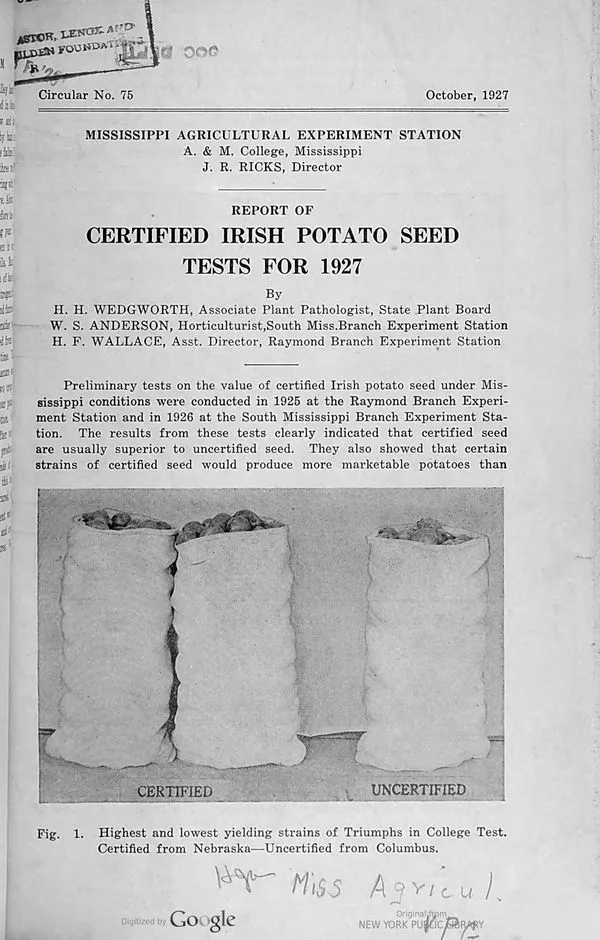
October 1927 · Bulletins & circulars · Mississippi
Report of certified Irish potato seed tests for 1927
H. H. Wedgworth, W. S. Anderson and H. F. Wallace
Mississippi Agricultural Experiment Station Circular · Circular 75, 8 pp., 3 figs.
Read PDF (opens in a new tab) Source (opens in a new tab) HHW-046
-
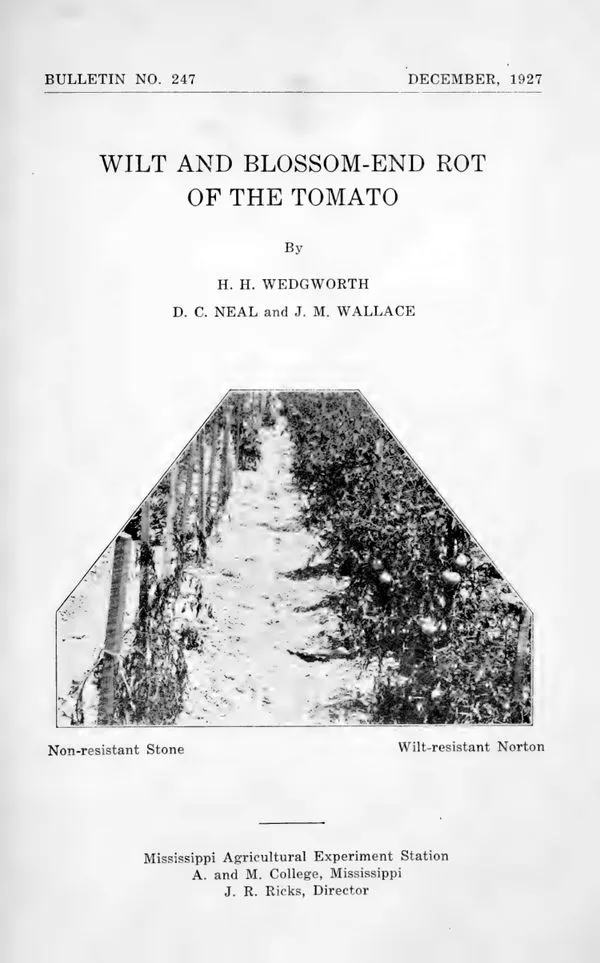
December 1927 · Bulletins & circulars · Mississippi
Wilt and blossom-end rot of the tomato: varietal susceptibility
H. H. Wedgworth, D. C. Neal and J. M. Wallace
Mississippi Agricultural Experiment Station Bulletin · Bulletin 247, 18 pp., 5 figs.
Several years of tomato variety tests on wilt-infested soil, plus 1927 blossom-end rot tests. Recommends Marglobe for early market and shipping, Louisiana Red/Pink for midseason gardens, Marvana as the earliest wilt-resistant variety, and Norton for late season. Marglobe and Kanora resisted blossom-end rot best.
Read PDF (opens in a new tab) Source (opens in a new tab) Archived copy (opens in a new tab) HHW-059
-
1928 · Annual reports · Mississippi
Annual report of the plant pathology department, 1928
D. C. Neal and H. H. Wedgworth
Mississippi Agricultural Experiment Station Annual Report (41st), 1928 · pp. 34-39
Note: Cited in later bibliographies; we have not yet seen these pages in the report itself.
Read PDF (opens in a new tab) Source (opens in a new tab) HHW-060
-
July 1928 · Articles · Mississippi
Cabbage yellows in Mississippi
H. H. Wedgworth
Quarterly Bulletin of the State Plant Board of Mississippi · Vol. 8, No. 2, pp. 7-9, fig. 1
Symptoms, cause (Fusarium conglutinans) and control with resistant strains. Damaged cabbage, collards and kale in Mississippi.
Read PDF (opens in a new tab) Source (opens in a new tab) HHW-072
-
July 1928 · Articles · Mississippi
Irish potato disease survey for 1928
H. H. Wedgworth
Quarterly Bulletin of the State Plant Board of Mississippi · Vol. 8, No. 2, pp. 12-13
April-May 1928 field inspections with USDA's Wm. Stuart and C. P. Close. Some so-called certified seed produced 50-75% mosaic. Urges growers to buy tagged state-certified seed and announces a 1929 survey.
Read PDF (opens in a new tab) Source (opens in a new tab) HHW-073
-
July 1928 · Articles · Mississippi
Experiments on the control of a narcissus root-rot
H. H. Wedgworth
Quarterly Bulletin of the State Plant Board of Mississippi · Vol. 8, No. 2, pp. 15-20, 2 figs.
Bulb disinfection trials against a Fusarium root rot. Six hours in Uspulun or Semesan, or one hour in 1:1,000 mercuric chloride, worked best.
Read PDF (opens in a new tab) Source (opens in a new tab) HHW-074
-
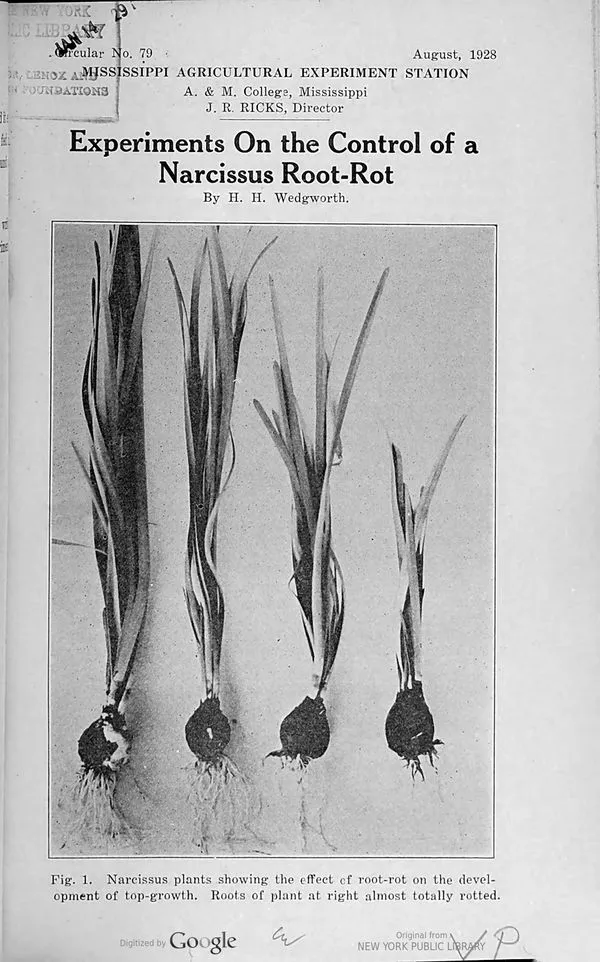
August 1928 · Bulletins & circulars · Mississippi
Experiments on the control of a narcissus root-rot
H. H. Wedgworth
Mississippi Agricultural Experiment Station Circular · Circular 79, 4 pp., 2 figs.
Read PDF (opens in a new tab) Source (opens in a new tab) HHW-078
-
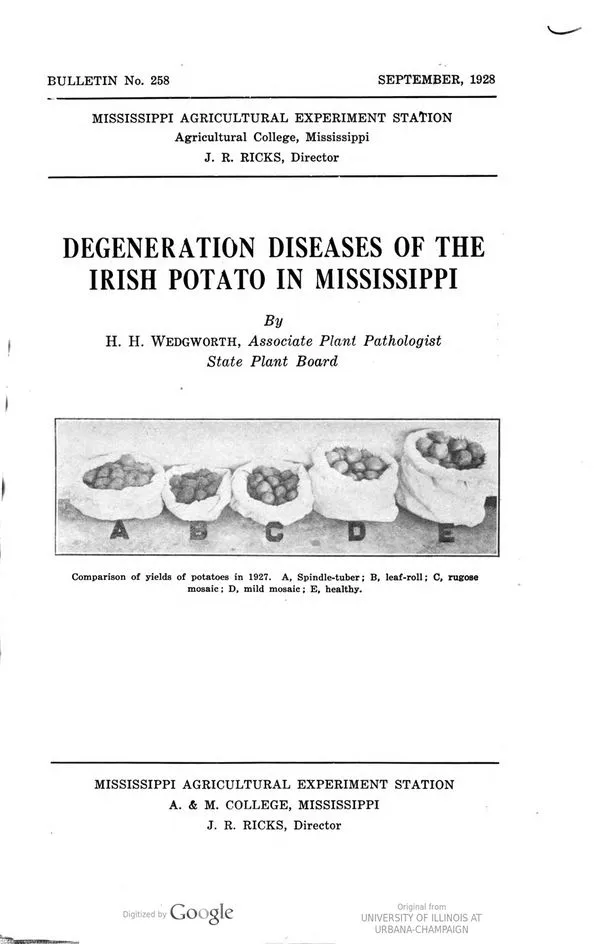
September 1928 · Bulletins & circulars · Mississippi
Degeneration diseases of the Irish potato in Mississippi
H. H. Wedgworth
Mississippi Agricultural Experiment Station Bulletin · Bulletin 258, 11 pp., 7 figs.
Mosaic (rugose and mild), leaf roll and spindle tuber, with 1927-28 yield trials. Leaf roll did the most harm per plant; mosaic caused the most total loss. Recommends disease-free stock, tuber-unit planting, roguing and isolated seed plots.
Read PDF (opens in a new tab) Source (opens in a new tab) Archived copy (opens in a new tab) HHW-080
-
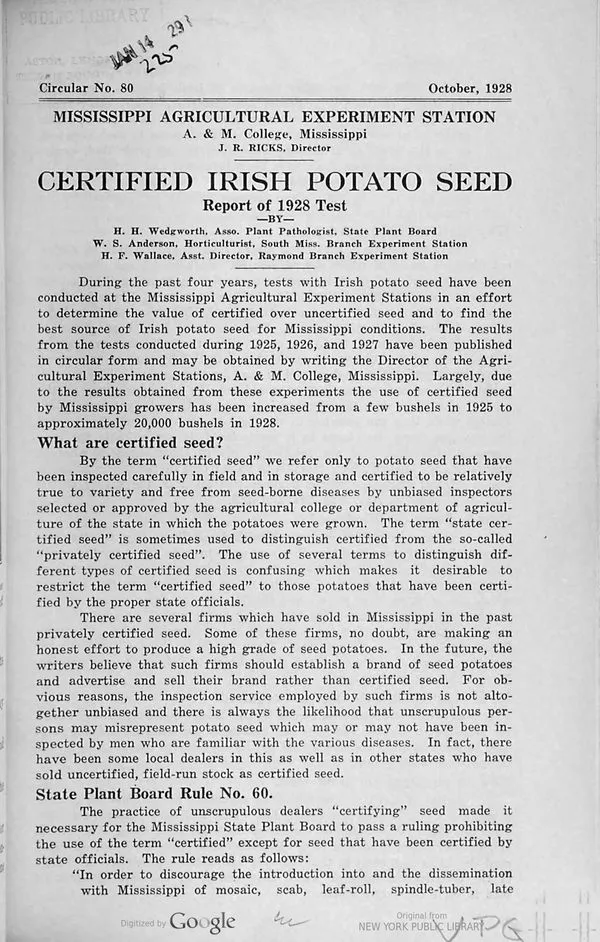
October 1928 · Bulletins & circulars · Mississippi
Certified Irish potato seed: report of 1928 test
H. H. Wedgworth, W. S. Anderson and H. F. Wallace
Mississippi Agricultural Experiment Station Circular · Circular 80, 7 pp.
Read PDF (opens in a new tab) Source (opens in a new tab) HHW-081
-
October 1928 · unsigned report of his work · Mississippi
Tomato wilt tests in 1928
Unsigned (staff); reports tests by H. H. Wedgworth
Quarterly Bulletin of the State Plant Board of Mississippi · Vol. 8, No. 3, p. 8
Credits his workLouisiana Red and Louisiana Pink ranked high for two years. Marglobe did poorly in 1928. Some seed sold as wilt-resistant was not. Cites Bulletins 247 and 261.
Read PDF (opens in a new tab) Source (opens in a new tab) HHW-082
-
October 1928 · unsigned report of his work · Mississippi
Irish potato seed treatments
Unsigned (staff); reports experiments by H. H. Wedgworth
Quarterly Bulletin of the State Plant Board of Mississippi · Vol. 8, No. 3, p. 11
Credits his workA 30-minute 1:1000 bichloride dip gave 99.4% marketable potatoes, against 79.4% from untreated seed. It matched the organic mercury products at lower cost.
Read PDF (opens in a new tab) Source (opens in a new tab) HHW-083
-
October 1928 · unsigned report of his work · Mississippi
Certified Irish potato seed tests in 1928
Unsigned (staff); tests run in cooperation with H. H. Wedgworth
Quarterly Bulletin of the State Plant Board of Mississippi · Vol. 8, No. 3, p. 12
Credits his workSummarizes the branch-station tests published as Circular 80.
Read PDF (opens in a new tab) Source (opens in a new tab) HHW-084
-
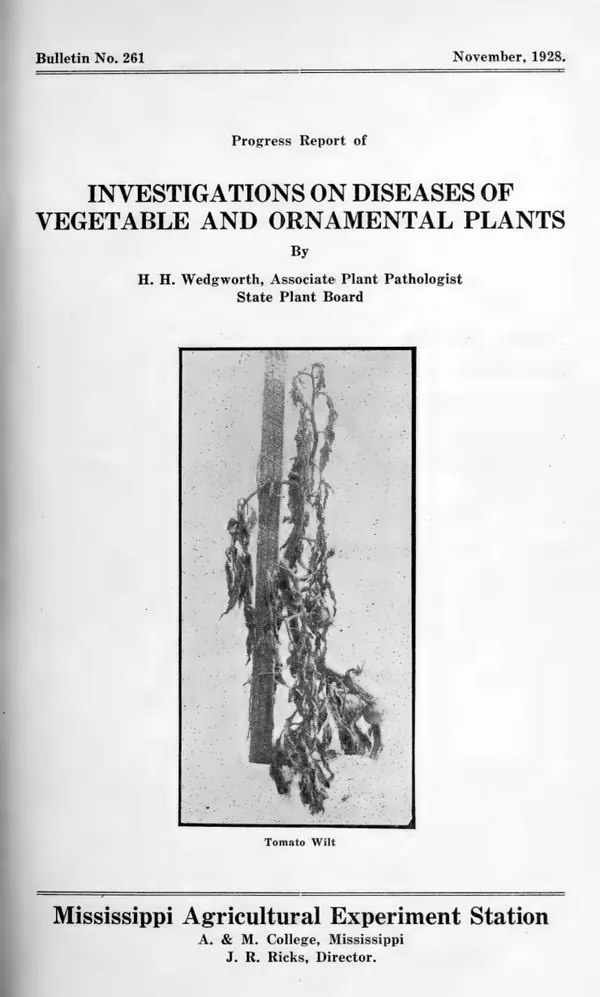
November 1928 · Bulletins & circulars · Mississippi
Progress report of investigations on diseases of vegetable and ornamental plants
H. H. Wedgworth
Mississippi Agricultural Experiment Station Bulletin · Bulletin 261, 21 pp., 3 figs.
1928 work on tomato wilt and blossom-end rot (p. 3), potato seed treatment, dusting and certified seed (pp. 6-9), sweet potato seed treatment and mosaic (pp. 9-10), cabbage yellows (p. 12), bean blight and mosaic (p. 14), pepper mosaic seed transmission (p. 17), gladiolus scab (p. 17) and narcissus root-rot (p. 21).
Read PDF (opens in a new tab) Source (opens in a new tab) Archived copy (opens in a new tab) HHW-085
-
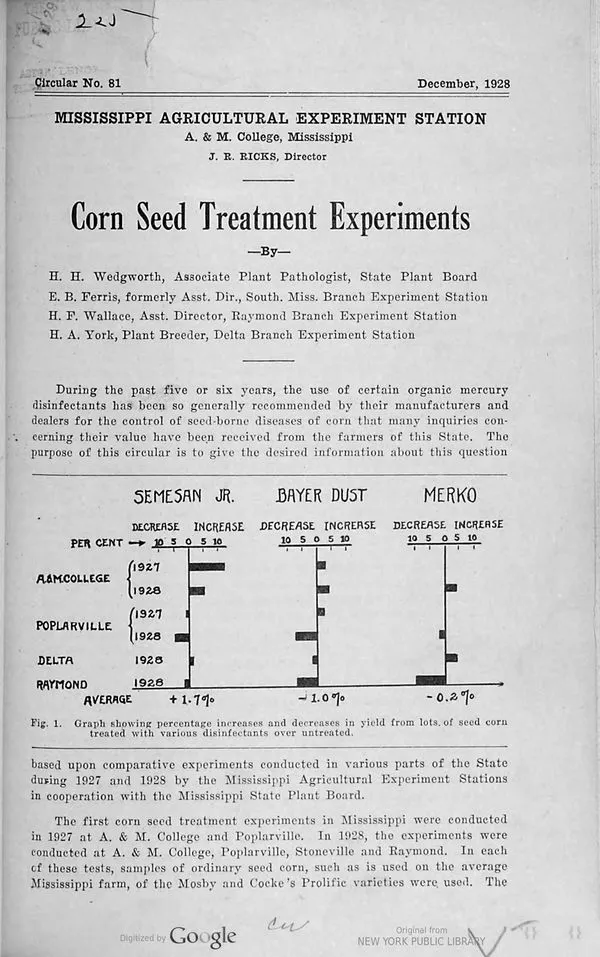
December 1928 · Bulletins & circulars · Mississippi
Corn seed treatment experiments
H. H. Wedgworth, E. B. Ferris, H. F. Wallace and H. A. York
Mississippi Agricultural Experiment Station Circular · Circular 81, 3 pp., 1 fig.
Read PDF (opens in a new tab) Source (opens in a new tab) HHW-086
-
1931 · Annual reports · Florida
Studies relative to plant pathology problems in the Everglades (State Project 124)
H. H. Wedgworth (project leader)
Florida Agricultural Experiment Station Annual Report (45th), fiscal year ending June 30, 1931 · pp. 156-158
Read PDF (opens in a new tab) Source (opens in a new tab) HHW-125
-
1931 · Annual reports · Florida
Investigations relative to the so-called "yellows" disease of beans (State Project 125)
H. H. Wedgworth
Florida Agricultural Experiment Station Annual Report, 1931 · pp. 158-159
Read PDF (opens in a new tab) Source (opens in a new tab) HHW-126
-
1932 · Annual reports · Florida
Studies relative to plant pathology problems in the Everglades (State Project 124)
H. H. Wedgworth (project leader)
Florida Agricultural Experiment Station Annual Report, 1932 · pp. 199-201
Read PDF (opens in a new tab) Source (opens in a new tab) Archived copy (opens in a new tab) HHW-129
-
1932 · Annual reports · Florida
Investigations relative to the so-called yellowing disease of beans (State Project 125)
H. H. Wedgworth
Florida Agricultural Experiment Station Annual Report, 1932 · pp. 201-202
Read PDF (opens in a new tab) Source (opens in a new tab) Archived copy (opens in a new tab) HHW-130
-
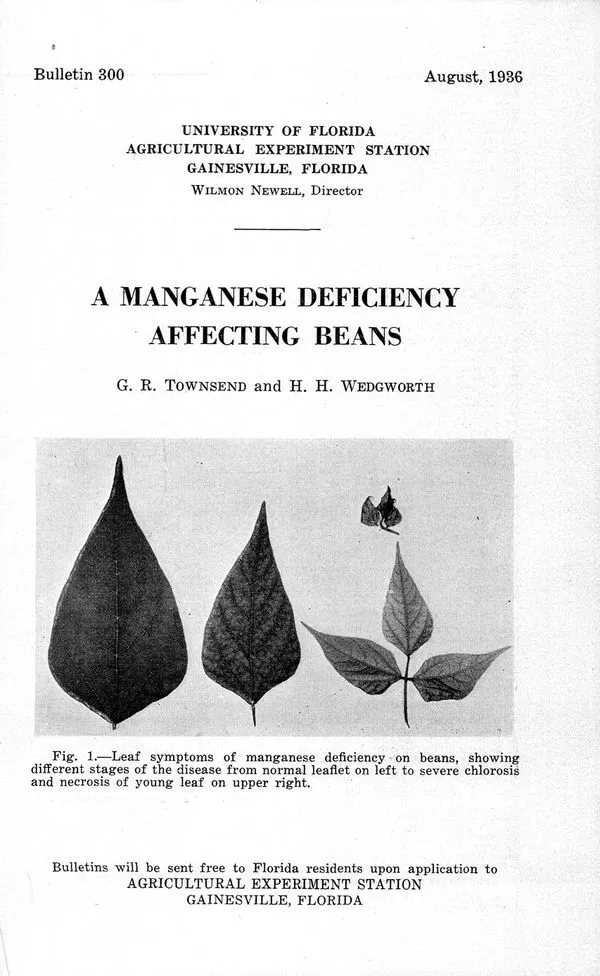
August 1936 · Bulletins & circulars · Florida
A manganese deficiency affecting beans
G. R. Townsend and H. H. Wedgworth
University of Florida Agricultural Experiment Station Bulletin · Bulletin 300, 23 pp. (24 pp. per the 1937 report), 6 figs.
Bean yellowing on weakly acid to alkaline Everglades peat comes from a lack of manganese. Light applications of manganese sulfate or sulfur, or both, correct it. Wedgworth (the junior author) ran the experiments from 1930 to 1932.
Read PDF (opens in a new tab) Source (opens in a new tab) Archived copy (opens in a new tab) HHW-133
-
September 1941 · posthumous report of his experiments · Florida
Relation of maturity in Bliss Triumph potato seed stocks to effectiveness of ethylene chlorhydrin and other treatments (reports his 1930-31 tests)
G. R. Townsend (author); experiments by H. H. Wedgworth
University of Florida Agricultural Experiment Station Bulletin (Technical) · Bulletin 362, p. 13 (text and footnote)
Credits his workHis spring 1930 and 1931 tests showed that newly harvested tubers are deeply dormant and must be cut before the chlorhydrin treatment works.
Read PDF (opens in a new tab) Source (opens in a new tab) Archived copy (opens in a new tab) HHW-134
Field notes and records
100 items
Short reports, specimen records and survey entries, mostly from the USDA plant disease and insect pest surveys, plus photographs and passages by other authors that credit his work.
1925 .
-
HHW-002 January 1925 Mississippi Data contribution Credits his work
Southern blight on soybeans: a new disease in Mississippi (readings by Anders and Wedgworth)
Quarterly Bulletin of the State Plant Board of Mississippi · Vol. 4, No. 4, pp. 1-5 (his readings pp. 3-5)
Mr. C. B. Anders, Assistant Director of the Branch Experiment Station of Raymond, Mississippi, and Mr. H. H. Wedgworth, Inspector of the State Plant Board, made the following readings relative to the amount of Southern blight in the experimental plots of beans at their station last summer.
-
HHW-003 April 1, 1925 Mississippi
Spring grain aphid on oats, Raymond (specimen sent by Wedgworth)
The Insect Pest Survey Bulletin (U.S. Bureau of Entomology) · Vol. 5, No. 1, p. 13
R. W. Harned (March 25): On March 6 H. H. Wedgworth sent in oat plants infested with the spring grain aphid, Toxoptera graminum, from the Branch Experiment Station at Raymond.
Source (opens in a new tab) Archived copy (opens in a new tab)
-
HHW-004 April 1, 1925 Mississippi
Colorado potato beetle feeding on cabbage, Hazlehurst, Copiah County
The Insect Pest Survey Bulletin (U.S. Bureau of Entomology) · Vol. 5, No. 1, p. 28
R. W. Harned (March 25): On March 18 H. H. Wedgworth collected a Colorado potato beetle feeding on cabbage at Hazlehurst, Copiah County.
Source (opens in a new tab) Archived copy (opens in a new tab)
-
HHW-005 April 1, 1925 Mississippi
Imported cabbage worm in cabbage fields around Crystal Springs
The Insect Pest Survey Bulletin (U.S. Bureau of Entomology) · Vol. 5, No. 1, p. 31
R. W. Harned (March 25): Mr. H. H. Wedgworth, Inspector for the State Plant Board, with headquarters at Raymond, reported the imported cabbage worm at work in several fields of cabbage around Crystal Springs on March 18.
Source (opens in a new tab) Archived copy (opens in a new tab)
-
HHW-006 April 1, 1925 Mississippi
Twelve-spotted cucumber beetle on cabbage, Mississippi (quoted report)
The Insect Pest Survey Bulletin (U.S. Bureau of Entomology) · Vol. 5, No. 1, pp. 31-32
R. W. Harned (March 25): Mr. Wedgworth has observed the 12-spotted cucumber beetle in large numbers on cabbage plants during February and March in Warren, Hinds, and Copiah Counties. His first report in regard to the abundance of these insects on cabbage plants was dated February 10. In regard to the injury caused to cabbage by these beetles, he writes as follows: "This pest may feed on any part of the leaf, but seems to prefer the under side. However, I have watched them feed for some time on the upper surface, and sometimes holes are eaten through the leaves. I have examined about 20 cabbage fields or about 60 or 70 acres and found this pest present in every field. I believe I am safe in estimating the damage at 1 per cent of the crop. In one field, at Yokena, the damage ran up to about 5 per cent or better. The principal injuries are, first, buds eaten out, heads will not form; second, attack on the young plants often means death to the plant, causing a poor stand."
-
HHW-012 December 1925 Mississippi
Report, Raymond Branch Experiment Station, 1925 (includes quoted report by Wedgeworth)
Mississippi Agricultural Experiment Station Bulletin · Bulletin 231, pp. 12-17 (his quoted report begins p. 12)
Several tests of various natures have been conducted on and around the Station that will be of especial interest to the trucking section. Mr. H. H. Wedgeworth of the State Plant Board, cooperating with the Station, had charge of this work. A part of Mr. Wedgeworth's report follows: POISONED-BAIT FOR THE CONTROL OF CUTWORMS. "During the spring of 1925 about 15% of the tomato plants were cut by cutworms in the Crystal Springs trucking section, and many other crops were also attacked. In many fields where no control measures were taken losses of from 75 to 90% were sustained."
1926 .
-
HHW-014 May 1, 1926 Mississippi
Tomato collar rot, Raymond, Hinds County (quoted letter of July 23, 1925)
The Plant Disease Reporter, Supplement 45 (Diseases of Vegetable and Field Crops in the United States in 1925) · Supplement 45, p. 40
Mississippi: This disease is quite common throughout this section (Raymond, Hinds County), and in some fields will cause a loss of 20 to 25 per cent. (H. H. Wedgworth, letter July 23, transmitting specimen which could not be determined.)
-
HHW-016 August 1, 1926 Mississippi
Oats crown rust (Puccinia coronata), Mississippi
The Plant Disease Reporter · Vol. 10, No. 4, p. 48
Oats - Puccinia coronata. Mississippi: Severe throughout the state. (Wedgworth, July 1)
-
HHW-017 August 1, 1926 Mississippi
Bacterial spot of peach (Bacterium pruni), Mississippi
The Plant Disease Reporter · Vol. 10, No. 4, p. 55
Mississippi: Generally severe throughout the state on young trees in an apparent low state of vitality. (Neal & Wedgworth, July 1)
-
HHW-018 August 15, 1926 Mississippi
Tomato wilt (Fusarium lycopersici), Mississippi
The Plant Disease Reporter · Vol. 10, No. 5, p. 73
Mississippi: Susceptible varieties of tomatoes show considerable wilt on soils infested with F. lycopersici. The average loss in the trucking sections was about 4 per cent. (Wedgeworth, July 15)
-
HHW-019 August 15, 1926 Mississippi
Tomato blossom-end rot, Mississippi
The Plant Disease Reporter · Vol. 10, No. 5, p. 73
Mississippi: Blossom-end rot has been reported from every section of the state. The greatest loss occurred in the Crystal Spring trucking section where a loss of about 30 per cent of the early crop was sustained. (Wedgeworth, July 15)
-
HHW-020 August 15, 1926 Mississippi
Tomato southern blight (Sclerotium rolfsii), Mississippi
The Plant Disease Reporter · Vol. 10, No. 5, p. 73
Southern blight (Sclerotium rolfsii). Mississippi: Reports of this disease have been received from several sections of the state. The writer observed one field of tomatoes that had about 35 per cent of the plants infected. Many fields show only a trace. (Wedgworth, July 15)
-
HHW-021 September 1, 1926 Mississippi
Sugar cane mosaic in Mississippi
The Plant Disease Reporter · Vol. 10, No. 6, p. 84
SUGAR CANE MOSAIC IN MISSISSIPPI. "A recent partial survey of the southern and central counties of the state show mosaic present in all cane fields of the Purple variety. Plantings of Cayana 10 were free of mosaic in all fields visited. The Purple variety showed an average infection of about 65 per cent, ranging from 5 per cent in a few small plantings to 100 per cent in many plantings." (Wedgworth, Aug. 15)
-
HHW-022 September 1, 1926 Mississippi
Watermelon wilt (Fusarium niveum), Mississippi
The Plant Disease Reporter · Vol. 10, No. 6, p. 86 (section heading p. 85)
Mississippi: Reported as severe in watermelon fields in four counties. (Neal & Wedgworth, Aug. 15)
-
HHW-023 September 1, 1926 Mississippi
Physalospora sp. on camphor tree (first report from any state)
The Plant Disease Reporter · Vol. 10, No. 6, p. 87
Physalospora sp. on camphor tree, collected by H. H. Wedgworth, Oktibbeha County, Aug. 16. First report from any state.
-
HHW-024 September 1, 1926 Mississippi
Cercospora hydrangeae on hydrangea (first report from Mississippi)
The Plant Disease Reporter · Vol. 10, No. 6, p. 87
Cercospora hydrangeae Ell. & Ev. on Hydrangea, collected by H. H. Wedgworth, Pearl River County, Mississippi, July 9. First report from this state.
-
HHW-025 September 15, 1926 Mississippi
Sweet potato mosaic, Mississippi
The Plant Disease Reporter · Vol. 10, No. 7, p. 96
Mosaic (undet.). According to Wedgworth, a trace of this disease has been reported from a large number of the sweet potato fields in nearly every section of Mississippi. (Aug. 15)
-
HHW-026 September 15, 1926 Mississippi
Sweet potato stem rot (Fusarium spp.), Mississippi
The Plant Disease Reporter · Vol. 10, No. 7, p. 97
Mississippi: More severe than usual in uncertified fields. (Wedgworth, Aug. 15)
-
HHW-027 September 15, 1926 Mississippi
Armillaria mellea on roots of deodar cedar
The Plant Disease Reporter · Vol. 10, No. 7, p. 99
Armillaria mellea on roots of Deodar cedar. Collected at A. & M. College, Miss., by H. H. Wedgworth, September 6. Determined by J. R. Weir.
-
HHW-030 October 1, 1926 Mississippi
Cotton diseases in Mississippi
The Plant Disease Reporter · Vol. 10, No. 8, pp. 105-106
COTTON DISEASES IN MISSISSIPPI. Collaborators Neal and Wedgworth of the Mississippi Agricultural Experiment Station have communicated the following interesting information concerning cotton diseases as of September 1.
-
HHW-031 October 15, 1926 Mississippi
Macrophoma phaseoli in Mississippi (quotes his letter of Sept. 29, 1926)
The Plant Disease Reporter · Vol. 10, No. 9, p. 120
After making inquiries concerning this reported Mississippi occurrence the following statement from H. H. Wedgworth of the Mississippi Experiment Station, in a letter of September 29 to W. A. Whitney of the Bureau of Plant Industry, has been received. This is the first direct report of this disease from Mississippi. The fungus was identified by C. A. Ludwig on specimens sent to him by Wedgworth from Mississippi. "Beans infected with a stem rot and having fruited bodies very similar to Macrophoma phaseoli have been collected from two fields in Oktibbeha County and from one field in George County. The disease was quite destructive, especially in one field this year. This particular field in Oktibbeha County suffered a loss of about 60 or 65 per cent of the plants from the spring planting. Unfortunately, the grower planted this field to fall beans and the disease has been prevalent in this planting also to the extent of about 50 per cent."
1927 .
-
HHW-032 April 1927 Mississippi Photographs
Photograph: pecan scab on twigs (Fig. 2, in D. C. Neal, 'Pecan diseases in Mississippi')
Quarterly Bulletin of the State Plant Board of Mississippi · Vol. 7, No. 1, p. 5, Fig. 2
Fig. 2. Pecan scab on twigs. Note spots with black center. (H. H. Wedgworth.)
-
HHW-034 July 30, 1927 Mississippi
Peach brown rot, Mississippi
The Plant Disease Reporter, Supplement 52 (Diseases of Fruit and Nut Crops in the United States in 1926) · Supplement 52, p. 51
Mississippi: Very severe on early varieties due in part to injuries resulting from a heavy hail storm and a wet spring. (Wedgworth)
-
HHW-035 July 30, 1927 Mississippi
Peach bacterial spot, Mississippi
The Plant Disease Reporter, Supplement 52 · Supplement 52, p. 59
Mississippi: Generally severe on young trees in an apparently low state of vitality. (Neal & Wedgworth)
-
HHW-036 July 30, 1927 Mississippi
Pecan scab on Stuart nuts collected by Wedgworth (in J. B. Demaree's report)
The Plant Disease Reporter, Supplement 52 · Supplement 52, p. 105
Scab infected nuts of the Stuart variety were collected this season by Wedgworth in Mississippi, and Boyd at Thomasville, Georgia.
-
HHW-037 August 15, 1927 Mississippi
Diseases of mulberry: Bacterium mori specimens from Mississippi
The Plant Disease Reporter · Vol. 11, No. 8, p. 92
The Survey has received specimens of Bacterium mori on Morus sp. from Wedgworth in Mississippi and of Phleospora moricola on M. rubra from Ludwig in South Carolina. In both cases these seem to be new reports for the state concerned.
-
HHW-038 August 30, 1927 Mississippi
Phoma bakeriana on cowpea pods, Mississippi
The Plant Disease Reporter, Supplement 53 (Diseases of Cereal and Forage Crops in the United States in 1926) · Supplement 53, p. 201
Phoma bakeriana Sacc. Reported by Wedgworth from Mississippi on pods. According to Diehl the fungus is similar to Phyllosticta phaseolina Sacc.
-
HHW-039 September 30, 1927 Mississippi
Tomato early blight (leaf spot form), Mississippi
The Plant Disease Reporter, Supplement 54 (Diseases of Vegetable and Field Crops in the United States in 1926) · Supplement 54, p. 256
Mississippi: Very severe on the early tomatoes, especially in the leaf spot form. (Wedgworth)
-
HHW-040 September 30, 1927 Mississippi
Ashy stem blight of bean, Mississippi (letter of Sept. 29, 1926, quoted)
The Plant Disease Reporter, Supplement 54 · Supplement 54, pp. 275-276
In Mississippi three scattered cases were found. Concerning the Mississippi situation H. H. Wedgworth wrote on September 29 as follows: "Beans infected with a stem rot and having fruited bodies very similar to Macrophoma phaseoli have been collected from two fields in Oktibbeha County and from one field in George County. The disease was quite destructive, especially in one field this year. This particular field in Oktibbeha County suffered a loss of about 60 or 65 per cent of the plants from the spring planting. Unfortunately, the grower planted this field to fall beans and the disease has been prevalent in this planting also to the extent of about 50 per cent."
-
HHW-041 September 30, 1927 Mississippi
Cotton anthracnose varietal resistance, Mississippi
The Plant Disease Reporter, Supplement 54 · Supplement 54, p. 308
Neal and Wedgworth of Mississippi stated that the varieties Miller, Acala, Delfos, and Trice showed evidences of being slightly resistant.
-
HHW-042 September 30, 1927 Mississippi
Sugar cane mosaic survey, Mississippi (quoted, Aug. 15)
The Plant Disease Reporter, Supplement 54 · Supplement 54, p. 318
In Mississippi, Wedgworth reported as follows, August 15: "A recent partial survey of the southern and central counties of the state shows mosaic present in all cane fields of the Purple variety. Plantings of Cayana 10 were free of mosaic in all fields visited. The Purple variety showed an average infection of about 65 per cent, ranging from 5 per cent in a few small plantings to 100 per cent in many plantings."
-
HHW-047 October 30, 1927 Mississippi
Armillaria mellea root rot of deodar cedar, A. & M. College
The Plant Disease Reporter, Supplement 55 (Diseases of Forest and Shade Trees, Ornamental and Miscellaneous Plants in the United States in 1926) · Supplement 55, p. 336
Armillaria mellea (Vahl) Quel., root rot. Mississippi - A. & M. College, Oktibbeha County, September 6. (Wedgworth)
-
HHW-048 October 30, 1927 Mississippi
Physalospora sp. on camphor, A. & M. College
The Plant Disease Reporter, Supplement 55 · Supplement 55, p. 349
Physalospora sp. Mississippi - A. & M. College; Oktibbeha County, Aug. 16. (Wedgworth)
-
HHW-049 October 30, 1927 Mississippi
Sycamore anthracnose near A. & M. College
The Plant Disease Reporter, Supplement 55 · Supplement 55, p. 352
Mississippi - very serious in vicinity of A. & M. College, June 1. (Wedgworth)
-
HHW-050 October 30, 1927 Mississippi
Leaf blister (Taphrina coerulescens) on Quercus rubra
The Plant Disease Reporter, Supplement 55 · Supplement 55, p. 354
QUERCUS RUBRA, red oak. Taphrina coerulescens (Mont. & Desm.) Tul., leaf blister. ... Mississippi - very susceptible. (Wedgworth 113)
-
HHW-051 October 30, 1927 Mississippi
Oak leaf blister: species susceptibility and control on the A. & M. campus
The Plant Disease Reporter, Supplement 55 · Supplement 55, p. 355; bibliography p. 392
Mississippi - many complaints received from owners of valuable shade trees; practically all species of oaks attacked; some species much more susceptible than others; Quercus nigra and Q. rubra very susceptible; Q. phellos has shown marked resistance. Several individuals of this species have been observed to be free of this disease on the Mississippi A. & M. College campus, while adjacent trees of Q. nigra from 50 to 95 per cent of the leaves affected; disease may be checked by spraying with Bordeaux in early spring, dormant spray as for peach leaf curl should be tried. (Wedgworth, 113)
-
HHW-052 October 30, 1927 Mississippi
Snapdragon stem rot (Sclerotium rolfsii), Meridian
The Plant Disease Reporter, Supplement 55 · Supplement 55, p. 359
Sclerotium rolfsii Sacc., stem-rot. Mississippi - Meridian, Lauderdale County, Aug. 10. (Wedgworth).
-
HHW-053 October 30, 1927 Mississippi
Dahlia stem rot (Sclerotium rolfsii), Meridian
The Plant Disease Reporter, Supplement 55 · Supplement 55, p. 366
Sclerotium rolfsii, Sacc., stem-rot. Mississippi - Meridan, Aug. 10. (Wedgworth).
-
HHW-054 October 30, 1927 Mississippi
Euonymus crown gall, Ocean Springs
The Plant Disease Reporter, Supplement 55 · Supplement 55, p. 368
EUONYMUS sp., burningbush, wahoo. Bacterium tumefaciens EFS. and Town. crown gall. Mississippi - Ocean Springs, Jackson Co., Aug. 10. (Wedgworth).
-
HHW-055 October 30, 1927 Mississippi
Euonymus japonicus powdery mildew (Oidium), Greenwood
The Plant Disease Reporter, Supplement 55 · Supplement 55, p. 368
Oidium euonymi-japonici (Arcangeli) Sacc., powdery mildew. Mississippi - Greenwood, Leflore Co., June 10. (Wedgworth).
-
HHW-056 October 30, 1927 Mississippi
Hydrangea leaf spot (Cercospora hydrangeae), Picayune
The Plant Disease Reporter, Supplement 55 · Supplement 55, p. 370
HYDRANGEA sp., hydrangea. Cercospora hydrangeae Ell. and Ev., leaf-spot. Mississippi - Picayune, Pearl River, July 9. (Wedgworth).
-
HHW-057 October 30, 1927 Mississippi
Iris leaf spot (Didymellina iridis), Dixon
The Plant Disease Reporter, Supplement 55 · Supplement 55, p. 370
Didymellina iridis (Desm.) Hoehn., leaf-spot. ... Mississippi - 2 reports but probably very common; Dixon, June 12. (Wedgworth).
-
HHW-058 October 30, 1927 Mississippi
Violet stem rot (Sclerotium rolfsii), Durant, Holmes County
The Plant Disease Reporter, Supplement 55 · Supplement 55, p. 378
Sclerotium rolfsii Sacc., stem-rot. Mississippi - Durant, Holmes Co., June 19. (Wedgworth)
1928 .
-
HHW-061 February 1928 Mississippi Photographs
Photograph: bacterial boll-rot (Fig. 13, in D. C. Neal, 'Cotton diseases in Mississippi and their control')
Mississippi Agricultural Experiment Station Bulletin · Bulletin 248, p. 25, Fig. 13
Fig. 13. Bacterial boll-rot. Note round, water-soaked spots on the bolls. (Photographed by H. H. Wedgworth).
-
HHW-062 May 15, 1928 Mississippi
Root knot (Caconema radicicola) on horseradish, Mississippi
The Plant Disease Reporter · Vol. 12, No. 1, p. 10
Caconema radicicola on horseradish, Mississippi, H. H. Wedgworth, April 9. Det. N. A. Cobb.
-
HHW-063 June 1, 1928 Mississippi
Apple crown gall on nursery stock, Mississippi
The Plant Disease Reporter, Supplement 60 (Diseases of Fruit and Nut Crops in the United States in 1927) · Supplement 60, p. 141
Mississippi: Frequently encountered on nursery stock. (Wedgworth)
-
HHW-064 June 1, 1928 Mississippi
Peach rosette, Mississippi
The Plant Disease Reporter, Supplement 60 · Supplement 60, p. 171
In 1927 rosette was reported from the three states of Mississippi, Tennessee, and Kentucky. The Kentucky report constitutes the first record of the occurrence of rosette in that state. In no case was the disease found to be serious. Wedgworth in Mississippi states that it is, as a rule, a minor disease.
-
HHW-065 June 1, 1928 Mississippi
Armillaria root rot of peach, Chickasaw County
The Plant Disease Reporter, Supplement 60 · Supplement 60, p. 177
Armillaria mellea (Vahl) Quel., root rot. Wedgworth reported that this disease occurred in Chickasaw County, Mississippi.
-
HHW-066 June 1, 1928 Mississippi
Mulberry blight (Bacterium mori) specimens from Mississippi
The Plant Disease Reporter, Supplement 60 · Supplement 60, p. 212
MULBERRY. Bacterium mori (Boyer & Lambert) emend. EFS., blight. Specimens were received from H. H. Wedgworth in Mississippi.
-
HHW-067 June 1, 1928 Mississippi
Citrus scab and melanose, Mississippi
The Plant Disease Reporter, Supplement 60 · Supplement 60, p. 213
Mississippi: The usual amount on grapefruit and Satsuma orange, causing very slight losses. (Neal and Wedgworth). ... Mississippi: Reported by Neal and Wedgworth as of minor importance; favored by ample moisture and warm temperatures; grapefruit and Satsuma oranges affected.
-
HHW-068 June 1, 1928 Mississippi
Fig root knot, Mississippi
The Plant Disease Reporter, Supplement 60 · Supplement 60, p. 217
Caconema radicicola (Greef) Cobb, root knot, moderately important in Mississippi (Wedgworth), also prevalent in Texas (Taubenhaus).
-
HHW-069 June 1, 1928 Mississippi
Fig rust and fig anthracnose, Mississippi
The Plant Disease Reporter, Supplement 60 · Supplement 60, pp. 217 (rust), 218 (anthracnose)
Cerotelium fici (Cast.) Arth., rust. Of slight importance in Mississippi (Neal and Wedgworth) ... Glomerella cingulata (Ston.) Spauld. and Schrenk, anthracnose. Slight loss reported from South Carolina (Ludwig), and from Mississippi. (Neal and Wedgworth).
-
HHW-070 June 1, 1928 Mississippi
Pecan scab: varietal susceptibility (Table 54) and dust vs. Bordeaux control
The Plant Disease Reporter, Supplement 60 · Supplement 60, p. 220
In Mississippi, Neal and Wedgworth found that four applications of monohydrated copper-lime dust gave evidence of some control but was not so effective as three applications of Bordeaux mixture.
-
HHW-071 June 1, 1928 Mississippi
Pecan rosette spreading beyond the Coastal Plain, Mississippi
The Plant Disease Reporter, Supplement 60 · Supplement 60, p. 221
According to Neal and Wedgworth in Mississippi, the disease is no longer confined to the Coastal Plains area but now occurs in many other parts of the state where trees are being planted.
-
HHW-075 July 1, 1928 Mississippi
Ashy stem blight of bean, Mississippi (1927)
The Plant Disease Reporter, Supplement 61 (Diseases of Vegetable and Field Crops (Other than Cereals) in the United States in 1927) · Supplement 61, p. 258
Mississippi: Less than last year. Loss a trace. Observed on both spring and fall plantings; greatest injury in seedling stage of fall planting. (Wedgworth)
-
HHW-076 July 1, 1928 Mississippi
Bean pod blight (Diaporthe), Mississippi
The Plant Disease Reporter, Supplement 61 · Supplement 61, p. 260
Diaporthe phaseolorum (Cke. & Ell.) Sacc. pod blight. ... Mississippi, present in slight amount. (Wedgworth)
-
HHW-077 July 1, 1928 Mississippi
Bean yeast spot (Nematospora), Pontotoc County
The Plant Disease Reporter, Supplement 61 · Supplement 61, p. 260
Nematospora phaseoli Wingard, yeast spot. ... Mississippi, found locally in Pontotoc County. (Wedgworth)
-
HHW-079 August 15, 1928 Mississippi
A new disease of Salvia (Sphaeropsis salviae), on a specimen from Brookhaven
The Plant Disease Reporter · Vol. 12, No. 7, p. 81
A NEW DISEASE OF SALVIA. A diseased plant of Salvia has been received from H. H. Wedgworth, collected at Brookhaven, Mississippi, in July. The organism found to be present is Sphaeropsis salviae Hollos. This is the first report of its occurrence in the United States to the Plant Disease Survey. It has been found in Hungary. (G. Hamilton Martin)
-
HHW-087 December 31, 1928 Mississippi
Arborvitae Pestalozzia tip blight, Jackson
The Plant Disease Reporter, Supplement 65 (Diseases of Forest and Shade Trees, Ornamental and Miscellaneous Plants in the United States in 1927) · Supplement 65, p. 404
Pestalozzia sp., tip blight. ... Mississippi - Jackson, October. (Wedgworth).
-
HHW-088 December 31, 1928 Mississippi
Arborvitae Phoma sp., Grenada
The Plant Disease Reporter, Supplement 65 · Supplement 65, p. 404
Phoma sp. Mississippi - Grenada, March 30 (Wedgworth).
-
HHW-089 December 31, 1928 Mississippi
Box leaf blight (Macrophoma candollei), Ridgeland
The Plant Disease Reporter, Supplement 65 · Supplement 65, p. 414
BUXUS SEMPERVIRENS, box. Macrophoma candollei (Berk. & Br.) Berl. and Vogl., leaf-blight. ... Mississippi - Ridgeland, February 5. (Wedgworth).
-
HHW-090 December 31, 1928 Mississippi
Box Phoma sp., Ridgeland
The Plant Disease Reporter, Supplement 65 · Supplement 65, p. 414
Phoma sp. Mississippi - Ridgeland, February 5. (Martin and Wedgworth).
-
HHW-091 December 31, 1928 Mississippi
Sclerotium rolfsii stem rot of cosmos, Canton
The Plant Disease Reporter, Supplement 65 · Supplement 65, p. 418
Sclerotium rolfsii, Sacc., stem-rot. Mississippi - Canton, May 18. (Wedgworth).
-
HHW-092 December 31, 1928 Mississippi
Delphinium Sclerotium root and crown rot, Starkville
The Plant Disease Reporter, Supplement 65 · Supplement 65, p. 419
Mississippi - general; Starkville, April 21. (Wedgworth).
-
HHW-093 December 31, 1928 Mississippi
Forsythia root knot, West Point
The Plant Disease Reporter, Supplement 65 · Supplement 65, p. 421
FORSYTHIA SP., forsythia, goldenbell. Caconema radicicola (Greef) Cobb, root-knot. Mississippi - West Point, February 25. (Wedgworth).
-
HHW-094 December 31, 1928 Mississippi
Gardenia Phyllosticta leaf spot, Yazoo City
The Plant Disease Reporter, Supplement 65 · Supplement 65, p. 421
Phyllosticta sp., leaf-spot. Mississippi - Yazoo City, April 11. (Wedgworth). Determination made by N. O. Howard.
-
HHW-095 December 31, 1928 Mississippi
Gladiolus Fusarium rot, Lyman
The Plant Disease Reporter, Supplement 65 · Supplement 65, p. 422
Fusarium spp., rot. Mississippi - Lyman, May 28. (Wedgworth).
-
HHW-096 December 31, 1928 Mississippi
Sweet pea Fusarium root rot/wilt, Bay Springs
The Plant Disease Reporter, Supplement 65 · Supplement 65, p. 425
Fusarium sp., root-rot, wilt. ... Mississippi - severe locally; Bay Springs, April 16. (Wedgworth).
-
HHW-097 December 31, 1928 Mississippi
English cherry laurel shothole, Jackson
The Plant Disease Reporter, Supplement 65 · Supplement 65, p. 425
LAUROCERASUS OFFICINALIS, English cherry-laurel. Shot-hole, undetermined. ... Mississippi - Jackson, June 29. (Wedgworth).
-
HHW-098 December 31, 1928 Mississippi
Rose Botrytis bud blight, Mississippi
The Plant Disease Reporter, Supplement 65 · Supplement 65, p. 429
Botrytis sp., cinerea type, bud blight. Reported from New York (Fitzpatrick (15:67), New Jersey (White), Mississippi (Martin and Wedgworth), Texas (Taubenhaus), Washington (Dept. Pl. Path.)
-
HHW-099 December 31, 1928 Mississippi
Rose Cercospora rosicola leaf spot (new state record)
The Plant Disease Reporter, Supplement 65 · Supplement 65, p. 429
Cercospora rosicola Pass., leaf-spot. Reported from South Carolina (Ludwig and Fenner), Mississippi (Wedgworth and Neal), ...
-
HHW-100 December 31, 1928 Mississippi
Rose Cladosporium fuscum leaf spot, Lauderdale and Jackson counties
The Plant Disease Reporter, Supplement 65 · Supplement 65, p. 429
Cladosporium fuscum Link, leaf-spot. Mississippi - Lauderdale and Jackson Counties, March 26. (Wedgworth and Neal).
-
HHW-101 December 31, 1928 Mississippi
Rose Pestalozzia sp.
The Plant Disease Reporter, Supplement 65 · Supplement 65, p. 430
Pestalozzia sp. Mississippi - scattered; March 31. Collected by Wedgworth and Neal. Determined by G. Hamilton Martin.
-
HHW-102 December 31, 1928 Mississippi
Smilax Phoma stem canker, A. & M. College
The Plant Disease Reporter, Supplement 65 · Supplement 65, p. 431
SMILAX SP., smilax. Phoma sp., stem canker. Mississippi - A. and M. College, February 20. Collected by H. H. Wedgworth. Determined by G. Hamilton Martin.
-
HHW-103 December 31, 1928 Mississippi
Spiraea root knot, Lumberton
The Plant Disease Reporter, Supplement 65 · Supplement 65, p. 431
Caconema radicicola (Greef) Cobb, root-knot. Mississippi - Lumberton, December 30. (Wedgworth).
1929 .
-
HHW-104 May 1, 1929 Mississippi
Potato tipburn, Mississippi (1928)
The Plant Disease Reporter, Supplement 68 (Diseases of Vegetable and Field Crops (Other than Cereals) in the United States in 1928) · Supplement 68, p. 31
Potato - Tipburn. Mississippi: While localized in occurrence tipburn was very severe. The earliest date of appearance noted was May 5. (Neal, Wedgworth, & Miles)
-
HHW-105 May 1, 1929 Mississippi
Tomato Fusarium wilt, Mississippi (1928)
The Plant Disease Reporter, Supplement 68 · Supplement 68, p. 35
Wilt was reported as serious only in certain southern and central states. Destructiveness in northern states appears to be confined largely to greenhouse-grown tomatoes. Damage in Mississippi was reported to be greatly lessened by the use of wilt-free seed. (Neal, Wedgeworth, Miles).
-
HHW-106 May 1, 1929 Mississippi
Tomato bacterial wilt, Mississippi (1928)
The Plant Disease Reporter, Supplement 68 · Supplement 68, p. 41
Mississippi: Not reported last year but has been rather prevalent this year. (Neal, Wedgworth, & Miles)
-
HHW-107 May 1, 1929 Mississippi
Sugar cane mosaic, Mississippi (1928)
The Plant Disease Reporter, Supplement 68 · Supplement 68, p. 103
Mississippi: One hundred per cent infection on purple, none on Cayana, 10 in fields observed (Neal, Wedgworth, and Miles).
-
HHW-108 June 1, 1929 Mississippi
Peach rosette at a new location, Tate County
The Plant Disease Reporter, Supplement 70 (Diseases of Fruit and Nut Crops in the United States in 1928) · Supplement 70, p. 219
A new location was also found in Tate County, northern Mississippi. This case was reported by Neal, Wedgworth and Miles and observed July 29.
-
HHW-109 June 1, 1929 Mississippi
Plum hypertrophy (Exoascus mirabilis), Mississippi
The Plant Disease Reporter, Supplement 70 · Supplement 70, p. 225
Exoascus mirabilis Atk., hypertrophy. A specimen was sent in to Washington by J. A. McClintock of Tennessee, also it was reported by Neal, Wedgworth and Miles as being somewhat more plentiful than usual in Mississippi.
-
HHW-110 June 15, 1929 Michigan
Apple scab, Michigan
The Plant Disease Reporter · Vol. 13, No. 3, p. 35
Michigan: Ascospores began discharging from the perithecia on the old leaves in the southern part of the state about March 21, in the central part about April 5, and in the northern part of the lower peninsula about April 9 and are still being discharged in all parts of the state. The first new scab lesions were collected from an unsprayed orchard near Fennville on May 6 and are very abundant at the present time on unsprayed and improperly timed sprayed orchards in all parts of the state. Infection on the young fruit was first noted on June 3 in an orchard in which nearly ten per cent of the fruit showed from one to five lesions. The indications are that Michigan will have a very severe scab year. Excellent control of scab has resulted in orchards where the sprays have been properly timed. (Wedgworth, June 5)
-
HHW-111 June 15, 1929 Michigan
Fire blight, Michigan
The Plant Disease Reporter · Vol. 13, No. 3, p. 36
Michigan: Fire blight is very severe in at least three orchards in the southern part of the state. In one orchard between 80 and 90 per cent of the blossoms were blighted. A great many trees will be destroyed by the disease in this orchard. At this time the total damage caused by fire blight has been very small. (Wedgworth, June 5)
-
HHW-112 June 15, 1929 Michigan
Cherry leaf spot (Coccomyces hiemalis), Michigan
The Plant Disease Reporter · Vol. 13, No. 3, p. 37
Michigan: The ascospores of the cherry leaf spot fungus are very abundant this season. They were mature on a few old leaves in the college orchard on April 5. An abundance of spores were being discharged on April 25 in the southern part of the state. Lesions have been found on the sweet and sour cherry in many sections of the state. (Wedgworth, June 5)
-
HHW-113 June 15, 1929 Michigan
Peach leaf curl, Michigan
The Plant Disease Reporter · Vol. 13, No. 3, p. 37
Michigan: The cool, wet weather prevalent during the past few weeks has been very favorable for leaf curl infection. The extremely wet weather during the early spring prevented the spraying of many orchards for curl and the results are that leaf curl is unusually severe. About 75 or 80 per cent of the leaves in unsprayed orchards are badly infected with this disease. (Wedgworth, June 5)
-
HHW-114 June 15, 1929 Michigan
Pear scab, Michigan (Survey paraphrase)
The Plant Disease Reporter · Vol. 13, No. 3, p. 38
PEAR scab (Venturia pyrina). ... H. H. Wedgworth on June 5 wrote that scab is very severe in some unsprayed Michigan pear orchards.
-
HHW-115 June 15, 1929 Michigan
Raspberry anthracnose (Plectodiscella veneta), Michigan
The Plant Disease Reporter · Vol. 13, No. 3, p. 39
RASPBERRY anthracnose (Plectodiscella veneta). Very severe in Michigan on the old canes in many blackcap fields. New lesions abundant on new canes in unsprayed fields. (Wedgworth, June 5)
-
HHW-116 August 1, 1929 Michigan
Bacterial spot of peach, Berrien County, Michigan
The Plant Disease Reporter · Vol. 13, No. 6, p. 81
Michigan: This disease is causing severe damage in several orchards in Berrien County. In some cases 75 to 90 per cent of the leaves and a large per cent of the fruit are infected. (H. H. Wedgworth, July 24)
-
HHW-117 August 1, 1929 Michigan
Michigan cherry diseases (brown rot; leaf spot)
The Plant Disease Reporter · Vol. 13, No. 6, p. 81
MICHIGAN CHERRY DISEASES. The following notes were contributed by H. H. Wedgworth, Michigan Agricultural College, June 24. Brown rot (Sclerotinia fructicola). Caused considerable blossom blight and twig blight early in the spring. It is now very severe in all neglected orchards. Seventy-five to 90 per cent of the fruit being attacked in some instances. Leaf spot (Coccomyces hiemalis). A large percentage of the leaves are turning yellow and falling from the trees in the unsprayed orchards in all parts of the state. Although the disease is very severe, it is not causing defoliation of the trees as early as it did last year. Properly sprayed orchards are practically free of leaf spot at this time.
-
HHW-118 August 1, 1929 Michigan
Raspberry diseases, Michigan section (with S. M. Zeller for Oregon)
The Plant Disease Reporter · Vol. 13, No. 6, pp. 82-83
RASPBERRY DISEASES. S. M. Zeller and H. H. Wedgworth have reported on the following raspberry diseases from Oregon, July 20, and Michigan, July 24, respectively. Anthracnose (Plectodiscella veneta). Weather conditions continue to be very favorable for this disease in Michigan. It is causing severe damage to the blacks and purples in most sections of the state. Its attack on the fruit has caused heavy losses in some cases. Powdery mildew (Sphaerotheca humuli). Several fields have been noted in which this disease is very severe in Michigan. In some instances the leaf tissues have apparently been killed from the attack of mildew.
-
HHW-119 December 30, 1929 Mississippi
Mississippi 1928 records in 'Diseases of forest and shade trees, ornamental and miscellaneous plants in the United States in 1928'
The Plant Disease Reporter, Supplement 73 · Supplement 73, pp. 374-389 (27 records); bibliography no. 22 (Circular 79), p. 396
Lophiostoma sp. Mississippi - Greenwood, June 26. Received from H. H. Wedgworth, determined by G. Hamilton Martin. ... [Bibliography] Wedgworth, H. H. Experiments on the control of a narcissus root rot. Mississippi Agr. Exp. Sta. Circ. 79. 4 pp. 1928.
1930 .
-
HHW-120 February 15, 1930 Michigan
Peach yellows, Michigan entry
The Plant Disease Reporter · Vol. 14, No. 4, p. 37
Michigan: About same as usual. Moderately important. Loss in yield estimated at 0.5 per cent. Thirty per cent affected trees noted in one planting. Noted this year in St. Joseph County for first time. (H. H. Wedgworth)
-
HHW-121 March 15, 1930 Michigan
Winter injury to peaches in Michigan (with Fig. 4 map)
The Plant Disease Reporter · Vol. 14, No. 6, pp. 47-48, fig. 4
WINTER INJURY TO PEACHES IN MICHIGAN. Although an extensive survey of the state of Michigan has not been made to determine the exact amount of injury caused by the sub-zero weather of January 18, it is believed that enough observations have been made to indicate the relative extent of the injury. The accompanying map gives the relative distribution of the injury in the state. ... It should be noted that the severe injury has occurred in Berrien and Van Buren Counties which include more than one-half of the Michigan peach industry. The aggregated losses from this freeze will amount to more than $1,500,000 to the peach industry of this state. (H. H. Wedgworth)
-
HHW-122 April 1, 1930 Michigan
Apple scab fungus maturing early, Ionia County, Michigan
The Plant Disease Reporter · Vol. 14, No. 7, p. 56
Michigan: Apple leaves collected on February 24 in Ionia County were placed in a moist chamber in the laboratory where ascospores were matured in 44 hours. The perithecia were very abundant on most of the leaves collected. The unusually warm weather which has prevailed during the past nine or ten days is no doubt the cause of the advanced condition of the fungus. (H. H. Wedgworth, Feb. 26)
-
HHW-123 April 1, 1930 Michigan
Apple scab in 1929, Michigan entry
The Plant Disease Reporter · Vol. 14, No. 7, p. 61
Michigan. Heavy rainfall during spring months made condition very favorable. Early temperatures low. From pink stage on very favorable. Loss estimated at 12 per cent. (H. H. Wedgworth)
-
HHW-124 June 15, 1930 Michigan
Cherry winter injury, Michigan 1928-29
The Plant Disease Reporter, Supplement 75 (Diseases of Plants in the United States in 1929) · Supplement 75, p. 35
WINTER INJURY. The heavy defoliation of 1928 by leaf spot left many cherry trees in Michigan in a very low state of vigor and as a result of temperatures of 18 to 22 degrees below zero thousands of trees were killed during the winter of 1928-29. (H. H. Wedgworth)
1931 .
-
HHW-127 August 21, 1931 Florida Talk (announced) Credits his work
Talk announced: 'Ten principal plant diseases during the past year and control measures' (Pahokee farm rally, Sept. 2, 1931)
The Lake Worth Herald · Aug. 21, 1931, p. 3, 'Plans Complete For Farm Rally'
Dr. H. H. Wedgworth, of the state experiment station at Belle Glade, and A. Frank, of Brown's Plantation, will talk on "Ten Principal Plant Diseases During the Past Year and Control Measures."
Source (opens in a new tab) Archived copy (opens in a new tab)
1932 .
-
HHW-128 1932 Florida Photographs
Photograph: controlled water-table celery seedbed studies at Shawano (Fig. 22)
Florida Agricultural Experiment Station Annual Report, fiscal year ending June 30, 1932 · p. 197 (UFDC image 199), Fig. 22
Fig. 22.—Preliminary installation of controlled water tables for celery seedbed studies at Shawano. Six central beds only are involved in the variable water table series. These from right to left and back to right are 6", 9", 12", 18", 24" and 30". The three long beds at the left are a fertility series involving 21 different soil treatments in triplicate. Photographed by Wedgworth, 12-12-32.
Source (opens in a new tab) Archived copy (opens in a new tab)
1933 .
-
HHW-131 1933 Florida Biographical entry Credits his work
Wedgworth, H(erman) H(amilton): biographical entry
American Men of Science, 5th edition (Science Press) · p. 1180
Gives his birth, degrees and posts from 1922 to 1930 onward.
Note: Read from search excerpts only; the full page is not openly available.
1934 .
-
HHW-132 June 15, 1934 Mississippi Specimen citations Credits his work
The rusts of Mississippi (cites his herbarium collections)
The Plant Disease Reporter · Vol. 18, No. 6, pp. ~54-74 (his specimens on pp. 56, 57, 58, 59, 67, 68)
CRONARTIUM COMANDRAE Pk. on Comandra umbellata, Oxford, Oct. 20, 1920, 22. ... On Pinus taeda, Mt. Olive, March 11, 1927, H. H. Wedgworth, 909. ... GYMNOSPORANGIUM CLAVIPES Cke. & Pk. ... On Juniperus virginiana, State College, Mar. 22, 1922, 488; Raymond, April 1, 1925, H. H. Wedgworth, 910. ... KUEHNEOLA MALVICOLA (Speg.) Arth. on Hibiscus syriacus, Laurel, July 20, 1921, 438; Gulfport, Aug. 20, 1926, H. H. Wedgworth, 913. ... Raymond, July 23, 1923, H. H. Wedgworth, 943. ... PUCCINIA XANTHII Schw. on Xanthium canadense, D'Lo, Sept. 18, 1929; State College, Aug. 16, 1928, H. H. Wedgworth, 921.
Note: One specimen is printed as collected at Raymond in July 1923, when he was still in Michigan. Probably a misprint.
About this catalog
We built this list from digitized journals, bulletins and USDA survey reports, and checked each item against an archive copy. Each item has a catalog ID (HHW-001 and up) and, where we have one, a library or archive identifier, so it can still be found if a link changes.
Found a mistake or something we missed? Let us know.
Back to our history